
Last Updated: June 8, 2026
Quick Answer: Yes, a demand letter can technically be handwritten – but it’s strongly not recommended. Courts and recipients treat typed letters as far more professional and credible. A handwritten letter is harder to read, easier to dismiss, and can weaken your case if things escalate to court. Always type your demand letter when possible.
You’re sitting at your kitchen table, frustrated and ready to act. Maybe your landlord is ignoring your calls about your security deposit. Maybe a contractor took your money and disappeared. You want to send a demand letter today – but you’re wondering: does it actually need to be typed, or can you just write it out by hand?
It’s a fair question. And the answer affects more than just appearances. This article covers what courts expect, what recipients respond to, and whether a handwritten demand letter can still get you results. By the end, you’ll know exactly what format to use – and why it matters.
What Is a Demand Letter?
A demand letter is a formal written notice you send to someone – a landlord, an employer, a contractor, or a business – asking them to take a specific action. That action is usually paying money they owe you or stopping behavior that’s causing you harm.
Think of it as your last formal warning before you take things to court. For example, if a contractor owes you $2,000 and won’t return your messages, a demand letter gives them a firm deadline to pay – and puts them on notice that court is your next step.
People use demand letters to resolve landlord disputes, unpaid wages, property damage, defective products, and much more. According to the legal definition of a demand letter, it serves as formal pre-litigation notice – one of the most effective tools for settling disagreements without ever stepping inside a courtroom.
Can a Demand Letter Be Handwritten – And Should It Be?
Legally, yes – a handwritten demand letter is valid in all 50 US states. No federal or state law requires a demand letter to be typed. Courts will accept it. Recipients are technically obligated to treat it the same as a typed one.
But here’s the practical reality: handwritten letters almost always hurt more than they help.
“A typed demand letter signals preparation and seriousness,” says attorney James Holloway, a civil litigation attorney with 14 years of experience. “Handwriting can look rushed or emotionally reactive – and that gives the other party a psychological edge before they’ve read a single word.”
Here’s what commonly happens when a demand letter is handwritten:
- Recipients take it less seriously than a typed letter
- Illegible words create room for the other party to dispute what was said
- Courts may view it as less organized or credible if the case goes to trial
- It’s nearly impossible to copy, scan cleanly, or email as a backup
- It signals that you’re acting out of emotion rather than legal knowledge
A typed letter, by contrast, shows you know your rights and you’re prepared to enforce them. That message alone often prompts the other party to respond.
When Should You Send a Demand Letter?
Send a demand letter when informal attempts to resolve a dispute have clearly failed. Here are the most common situations that call for one:
- Your landlord won’t return your security deposit after you’ve moved out and the legal return deadline has passed
- A contractor took your money but left the job unfinished or stopped responding entirely
- An employer owes you unpaid wages, overtime, or commissions and HR isn’t addressing it
- A business sold you a defective product and refused a refund after multiple complaints
- A neighbor or company is causing ongoing harm – noise, property damage, harassment – and won’t stop despite requests
- Someone owes you money from a personal loan or informal agreement and is now dodging you
Skipping the demand letter is a costly mistake. Many small claims courts require proof you sent one before they’ll hear your case. Even when it’s not required, that letter shows the judge you tried to resolve things reasonably first – and that matters.
What to Include in a Demand Letter
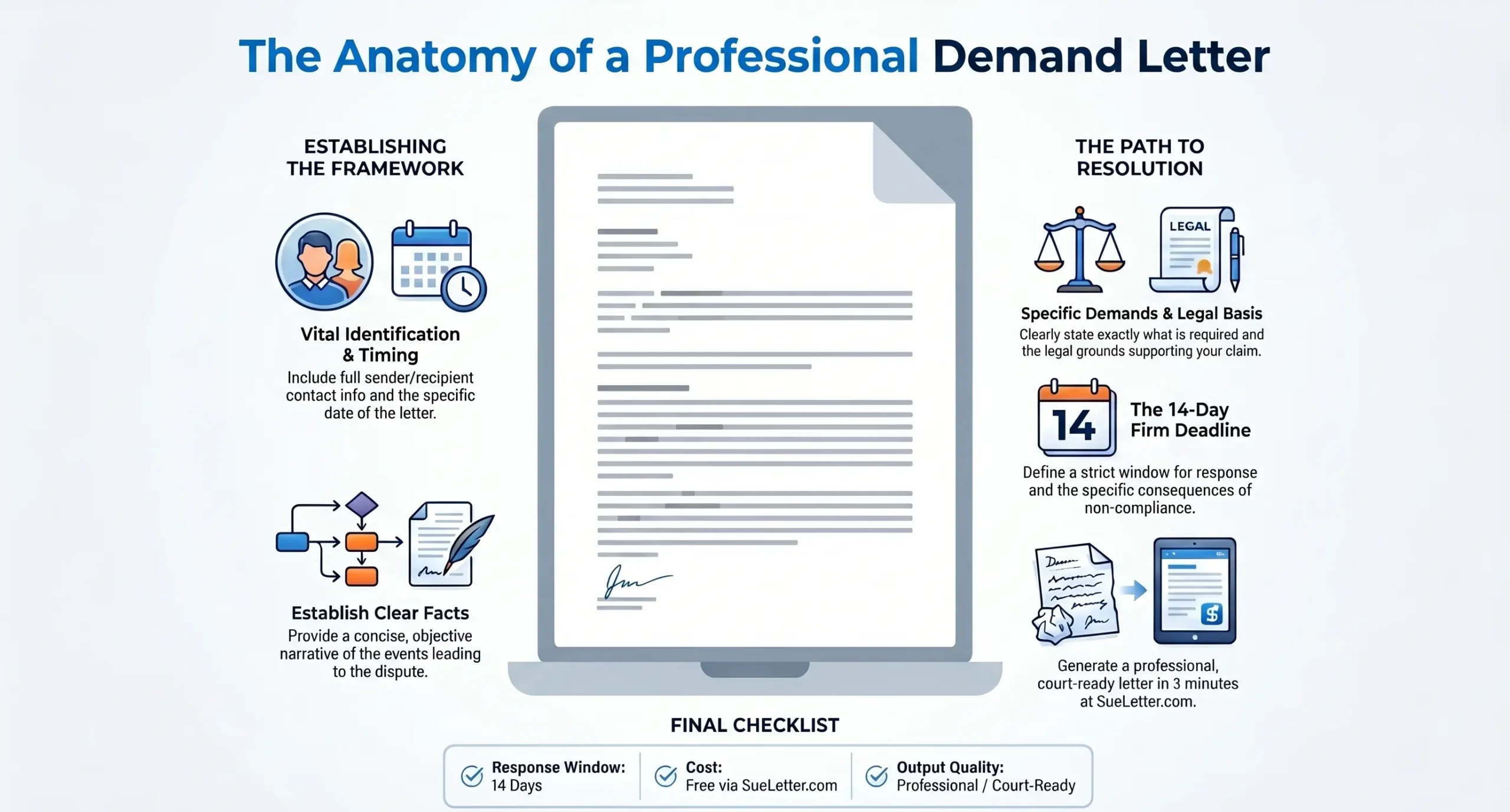
A strong demand letter covers eight key elements. Skip any one of them and you weaken your position.
- Your full name and contact information – Use your legal name, current address, phone number, and email address. Example: “From: James Carter, 145 Oak Street, Atlanta, GA 30301”
- The recipient’s full name and address – Use their legal name and most current mailing address. Example: “To: Maria Ruiz, Property Manager, 289 Elm Avenue, Atlanta, GA 30302”
- The date – Always include the exact date you’re writing. This is critical for legal deadlines and paper trails.
- A clear statement of facts – Describe what happened in plain, chronological order. No emotional language – just facts. Example: “On March 1, 2026, I vacated the property at [Address] and returned all keys in person.”
- Your specific demand – State exactly what you want. Be precise. Example: “I am demanding the return of my $1,400 security deposit in full.”
- The legal basis for your claim – Reference the law, contract clause, or agreement being violated. Example: “Under Georgia Code § 44-7-34, you are required to return the deposit within 30 days of move-out.”
- A firm deadline – Give the recipient a clear date to respond or comply. Fourteen days is the standard. Example: “Please remit full payment by June 21, 2026.”
- Consequences for non-compliance – State what happens next if they don’t act. Example: “If payment is not received by this date, I will file a claim in Magistrate Court without further notice.”
Demand Letter – Free Template
Use this clean, attorney-reviewed sample as your starting point:
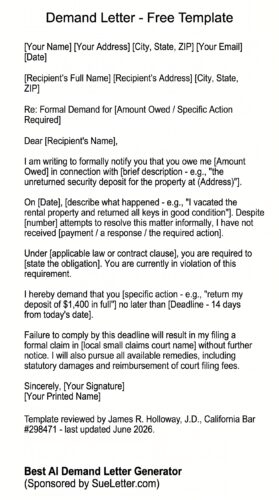
[Your Name] [Your Address] [City, State, ZIP] [Your Email] [Date]
[Recipient’s Full Name] [Recipient’s Address] [City, State, ZIP]
Re: Formal Demand for [Amount Owed / Specific Action Required]
Dear [Recipient’s Name],
I am writing to formally notify you that you owe me [Amount Owed] in connection with [brief description – e.g., “the unreturned security deposit for the property at (Address)”].
On [Date], [describe what happened – e.g., “I vacated the rental property and returned all keys in good condition”]. Despite [number] attempts to resolve this matter informally, I have not received [payment / a response / the required action].
Under [applicable law or contract clause], you are required to [state the obligation]. You are currently in violation of this requirement.
I hereby demand that you [specific action – e.g., “return my deposit of $1,400 in full”] no later than [Deadline – 14 days from today’s date].
Failure to comply by this deadline will result in my filing a formal claim in [local small claims court name] without further notice. I will also pursue all available remedies, including statutory damages and reimbursement of court filing fees.
Sincerely, [Your Signature] [Your Printed Name]
Template reviewed by James R. Holloway, J.D., California Bar #298471 – last updated June 2026.
How to Send a Demand Letter
Getting the format right is only half the job. How you send it matters just as much.

1. Certified mail with return receipt – always. USPS certified mail gives you a tracking number and a signed receipt when the letter is delivered. That receipt is legal proof of delivery. It’s the single most important step you can take to protect your case.
2. Send a copy by email as a backup. Email alone doesn’t always qualify as legal notice in every state. But as a backup to certified mail, it creates a clear timestamp and paper trail. Use a subject line like: “Formal Demand Letter – [Your Name] – [Date].”
3. Keep copies of everything. Photograph the sealed envelope before you mail it. Save your tracking number. Screenshot your email send confirmation. Keep all of this together in one folder – physical or digital.
4. If they refuse delivery, don’t panic. A refusal is legally significant in most states. Courts generally treat a refused certified letter as delivered. Keep your USPS tracking receipt showing the attempted delivery – it speaks for itself.
What Happens After You Send a Demand Letter?
Most people focus on writing the letter – and then have no idea what to do next. There are three ways this plays out:
They pay or comply. This happens more often than you’d expect. If they meet your demand, get confirmation in writing. A short written acknowledgment that the matter is resolved protects you from any future claims.
They respond but disagree. They may send a counter-offer or dispute your version of events. Respond calmly and in writing. Stick to facts. If their counter-offer is reasonable, you can negotiate. If not, move to the next step.
They ignore it completely. Silence is actually useful evidence. It shows a court that you made a good-faith effort to resolve the dispute and they refused. File your case following the federal small claims court guidelines, bring your demand letter and certified mail receipt, and let the judge see who came prepared.
Not sure what your next step is? Use our free demand letter generator – we’ll walk you through every stage of the process.
Does a Demand Letter Actually Work?
Yes – more often than most people expect. The American Bar Association notes that a large share of civil disputes are resolved before trial, and a well-written demand letter is frequently the turning point.
A letter works best when it’s typed and professionally formatted, cites the specific law or contract being violated, gives a firm but reasonable deadline, and arrives by certified mail with a delivery record.
A letter alone won’t resolve every dispute. If the other party has legal representation, is acting in clear bad faith, or the claim is highly complex, you may need an attorney. But for most everyday disputes under $10,000, a clear and factual demand letter is your most powerful first move – and often your only necessary one.
Pros and Cons of Writing Your Own Demand Letter
| Pros | Cons |
|---|---|
| Saves hundreds in legal fees | No guarantee the other party complies |
| Much faster than going to court | Incorrect format can weaken your case |
| Creates a clear legal paper trail | State-specific rules are easy to miss |
| Shows you’re serious and prepared | Emotional writing can hurt your credibility |
| Resolves the dispute in many cases | Recipient may still choose to ignore it |
The easiest way to get every element right – without paying legal fees – is to use SueLetter.com’s free demand letter generator. Answer five quick questions and it builds a court-ready, state-specific letter in minutes.
Demand Letter Format – What All States Agree On
No federal law mandates a specific demand letter format. But a few universal rules apply across every state, and understanding demand letter format requirements is the difference between a letter that holds up in court and one that gets thrown out entirely.
Typed is always the right choice. Handwritten letters are legally valid but treated as far less credible in disputes and in court.
Certified mail is the safest delivery method in every state for establishing legal proof of notice.
Fourteen to thirty days is the standard response window. Shorter feels aggressive; longer gives the other party room to stall.
State rules vary significantly beyond these basics. California allows 21 days for security deposit responses. Georgia requires deposit return within 30 days. Texas has specific required language for consumer protection demand letters. Always verify your state’s current demand letter format requirements – or use a generator that handles state-specific language automatically.
Laws change. Confirm your state’s current requirements or consult a local attorney before sending.
Frequently Asked Questions
Is a demand letter legally binding?
No – not on its own. A demand letter is formal written notice, not a court order. It tells the recipient what you want and what comes next. If they ignore it, you’ll need to file a lawsuit to enforce your claim legally.
Can I write a demand letter without a lawyer?
Yes, absolutely. Millions of people write their own demand letters every year. Courts don’t require attorney involvement. A well-structured template or online generator helps you avoid the most common formatting mistakes.
How long should a demand letter be?
One page is ideal – two pages at most. A shorter, focused letter is always more effective than a long, rambling one. State the facts, make your demand, set your deadline, and stop.
What if they ignore my demand letter?
Ignoring a demand letter doesn’t make your claim disappear. File your case in small claims court and bring the letter as evidence. Courts view non-response as a refusal to cooperate – and that works in your favor.
Should I send a demand letter by email or certified mail?
Send it by certified mail with return receipt first – always. Follow up with an email copy. Email alone doesn’t count as legal notice in every state, but certified mail holds up in court in all 50.
How long do I have to send a demand letter?
It depends on your claim type and state. Contract disputes typically carry a 4–6 year statute of limitations. Personal injury claims are often 2–3 years. Send your letter as soon as informal resolution has clearly failed – waiting only works against you.
Can a demand letter hurt my case?
Yes – if it’s threatening, emotionally charged, or factually inaccurate. Avoid personal attacks, exaggerated claims, or anything that reads as a threat of criminal action. Stick strictly to facts and legal rights only.
Does a handwritten demand letter hold up in court?
Technically yes – courts will accept it. But it may hurt your credibility. A typed, organized letter signals preparation and legal awareness. Judges and opposing parties notice the difference, and it affects how your case is perceived from the very start.
You’re Now Ready to Write One That Works
You now know that a handwritten demand letter is legal – but typed is always the smarter, stronger choice. Demand letter format requirements, delivery method, and the eight key elements covered above are what separate a letter that gets results from one that gets ignored.
Ready to write yours? Visit SueLetter.com and use our free demand letter generator – it takes 3 minutes, and your letter will be ready to print and send today.
Reviewed by James R. Holloway, J.D., California Bar #298471 | Last Updated: June 8, 2026 Disclaimer: This article is for informational purposes only and does not constitute legal advice. Laws vary by state. Consult a licensed attorney for advice specific to your situation.